OmaStadi ↗
Helsinki
Residents propose and choose local projects.
31,103 voters · €10m budget2026 round
Build tools that give people a meaningful say.

Postdoc · ETH Zurich
PhD · ETH Zurich
Computational Social Science team
PhD thesis: Designing computational methods for digital democracy
Participatory budgeting
Helped design the city’s first programme
Kultur Komitee
Process design over three years
vTaiwan
Active member
Murmi
App design for the Swiss AI Futures citizens’ assembly

Where do you already make decisions together?



Shared budgets · Workplace decisions · Citizens’ assemblies · Referendums
Propose projects and decide what gets funded.
OmaStadi · Helsinki
Bring local experiences into a shared picture.
VelObserver · Zürich
Compare reasons, question claims and revise views.
Discussions · Argument mapsHow does a contribution become part of a decision?

Define the purpose and participants

Bring knowledge and possibilities together
Compare reasons and perspectives
Turn preferences into a decision

Explain, follow through and learn
A shared starting point. Adapt it to the process; revisit earlier steps.
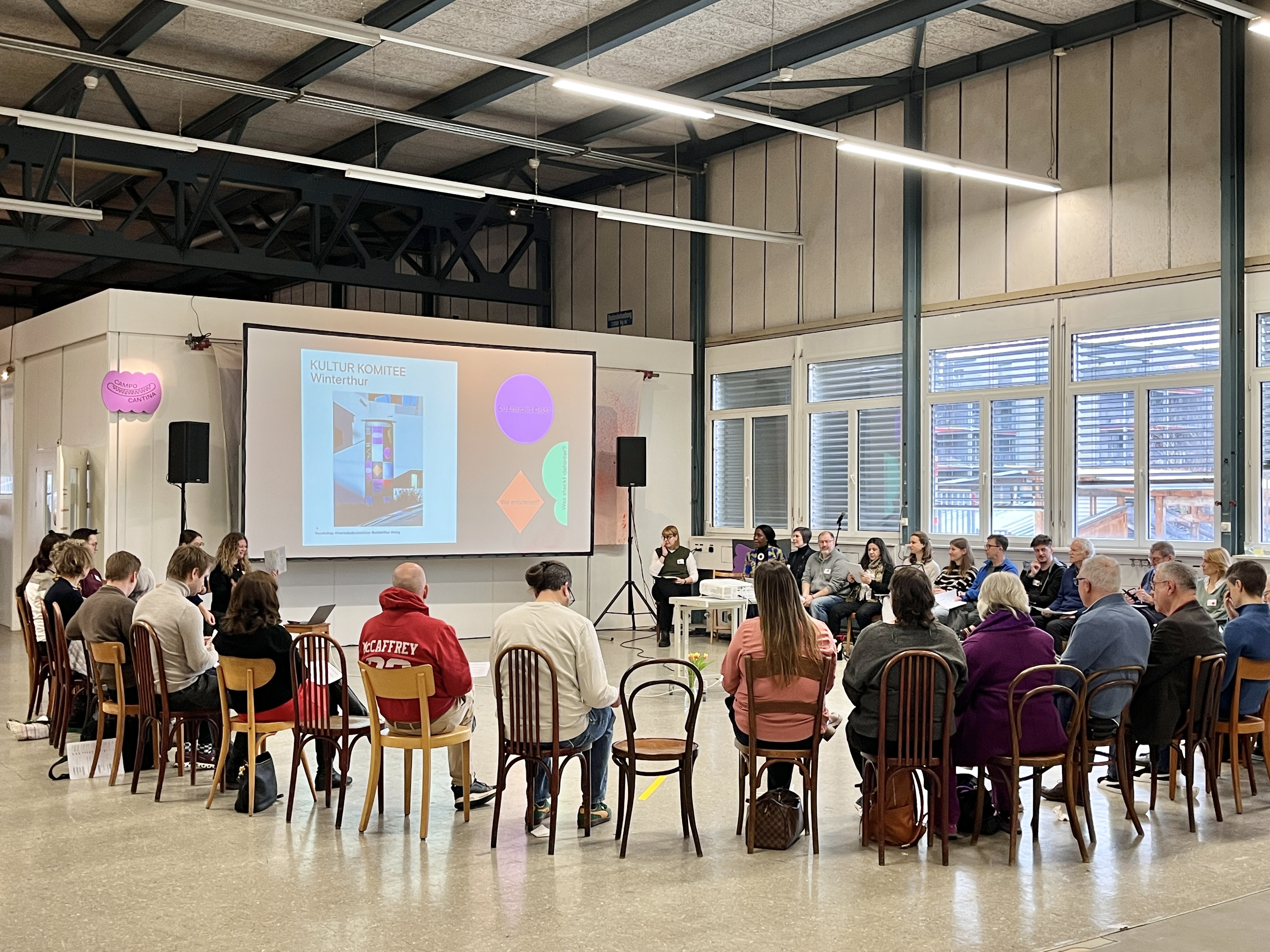
A residents’ assembly that funds art and cultural projects in Winterthur.
I’ve worked on its voting and funding process for three years.
distributed to art projects in Winterthur across those three years.
What are we deciding, and who should take part?
Citizen initiativesHelp people turn a concern into a clear public question.
Citizens’ assembliesMap who is affected and whose experience is missing.
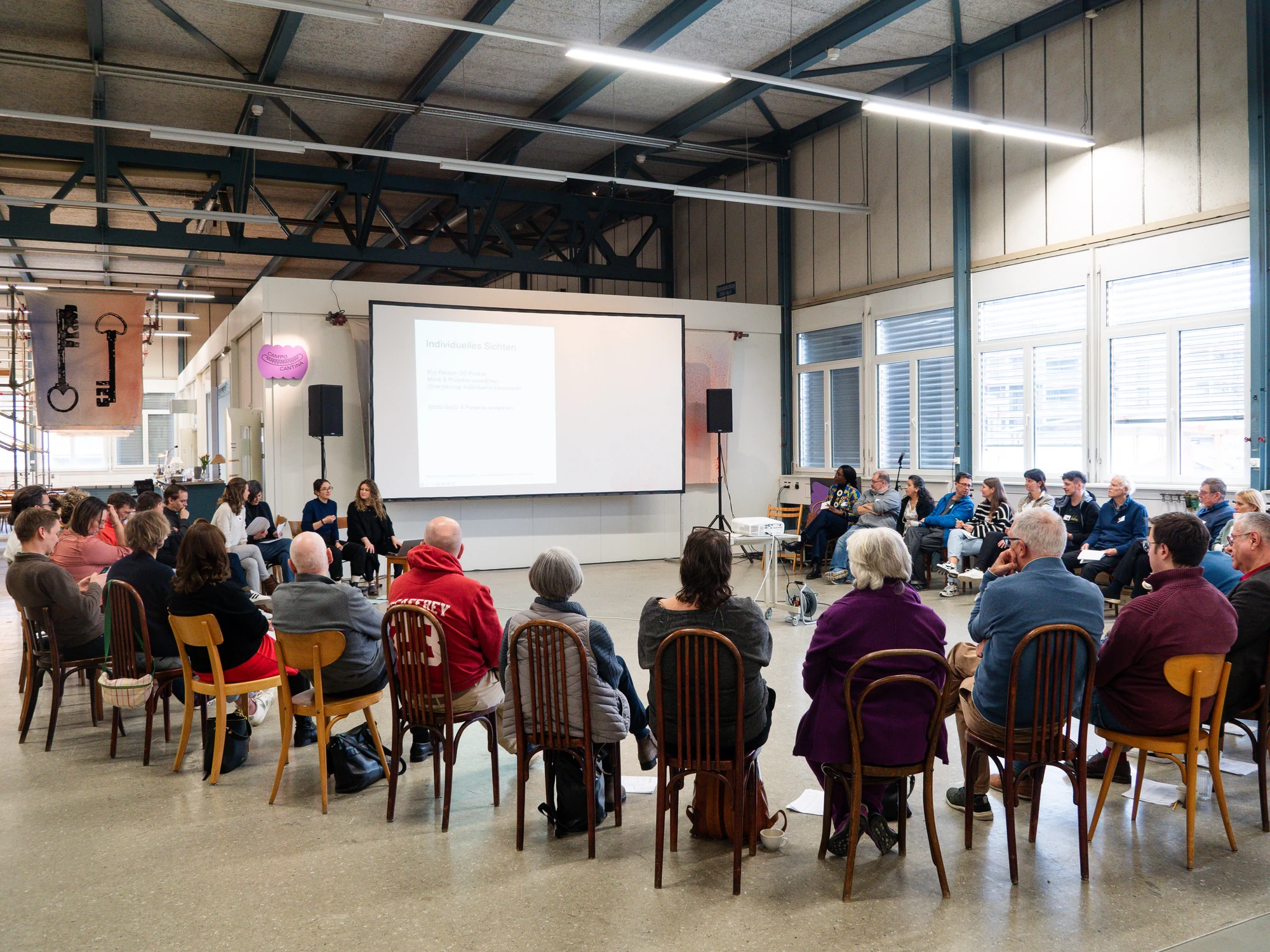
Kultur Komitee · 2025
Selected at random
Funding for local culture
Follow an existing decision from start to finish. Where do people already have a say—and where does their influence stop?
What do people know, need or propose?
Participatory budgetingHelp residents develop and compare feasible proposals.
Neighbourhood planningCollect local knowledge and explore alternative designs.
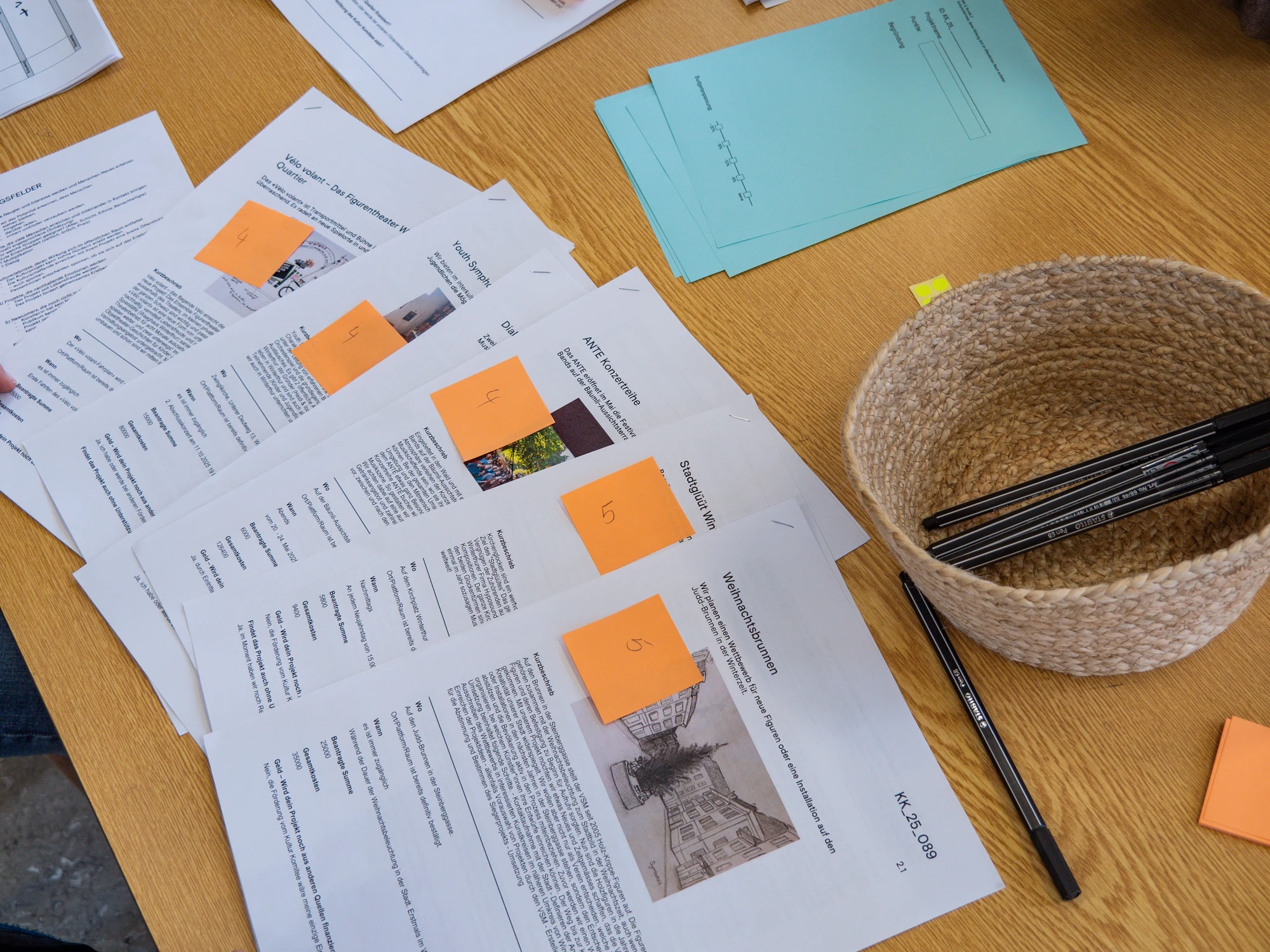
Residents compare project descriptions, requested amounts and the criteria used to assess them.
How can people compare reasons and perspectives?
Public consultationsCompare arguments and surface unresolved disagreements.
Multilingual assembliesSupport translation, source checking and fair summaries.
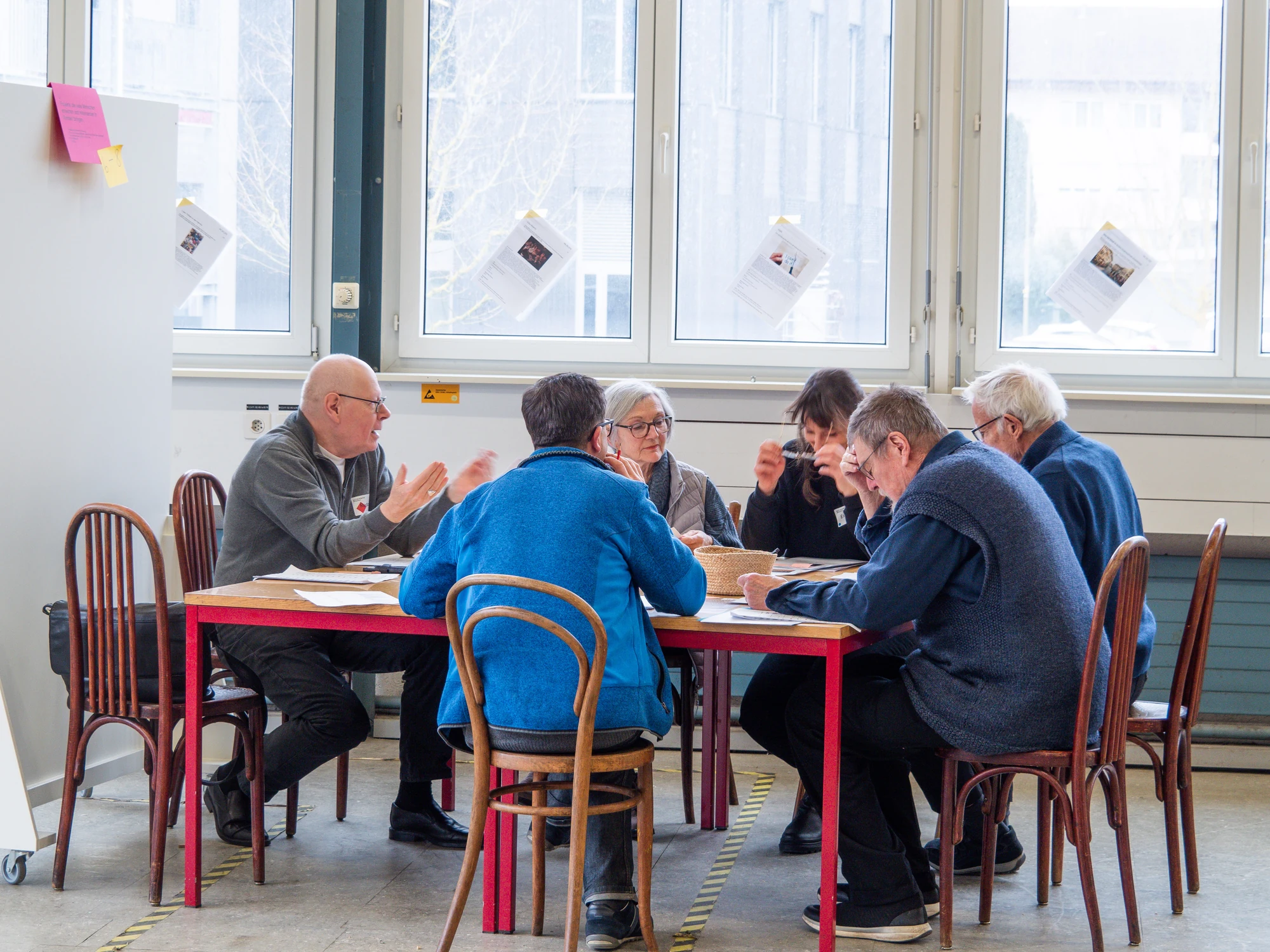
Residents discuss how each proposal could contribute to the cultural goals the group has agreed on.
People can review the main themes and point out what is missing.
Their comments provide the material for a group summary.
Contribute → organize themes → participant review. People can check and correct the shared interpretation.
Workshop interface; controls illustrate the process.
Open Murmi ↗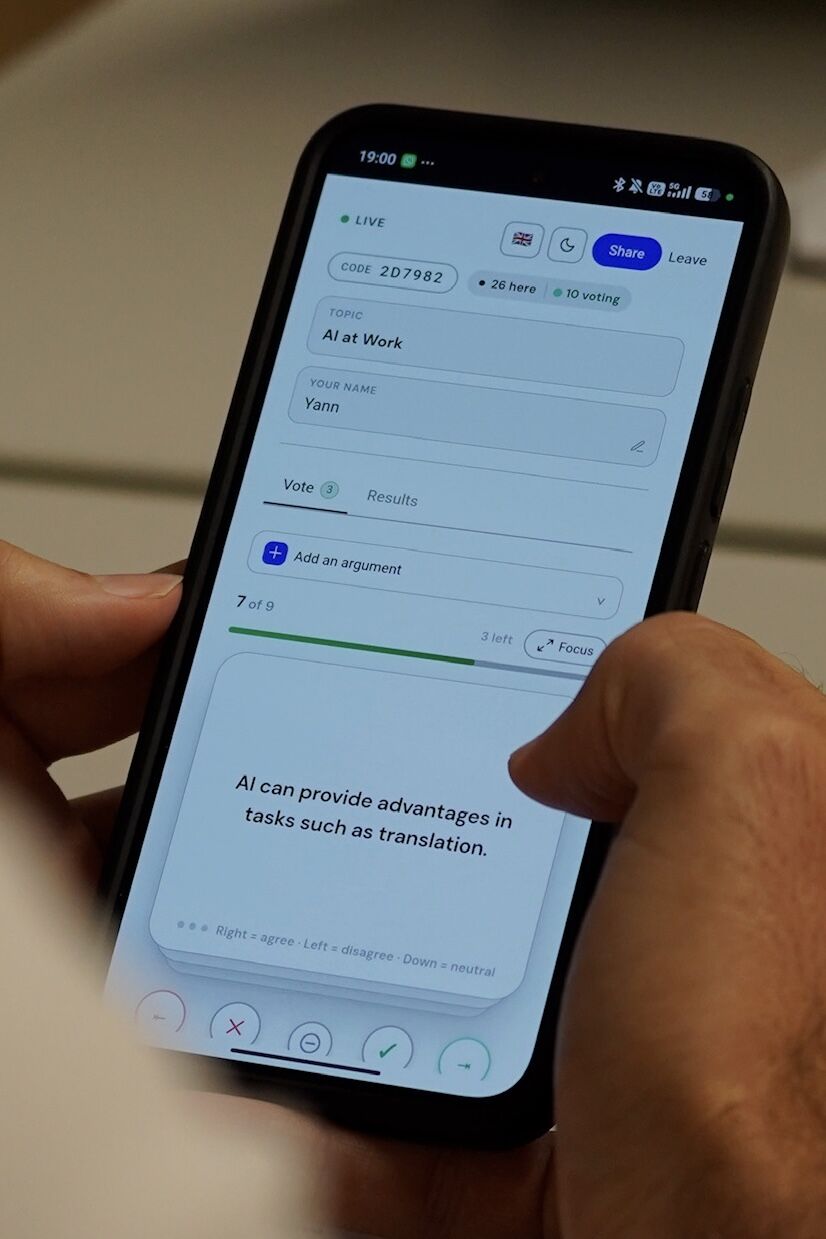
A neat summary can hide a real disagreement. What should stay visible, even when it complicates the result?
How do preferences become a collective decision?
ReferendumsLet people explore how ballot wording changes the choice.
Shared budgetsCompare voting rules and which groups each outcome serves.
Each person
Give individuals equal weight.
Each community
Ensure distinct groups have a voice.
Who should your system represent—and how?

Residents decide what their city funds
Residents voted with 10 points.
The Method of Equal Shares allocated the budget.
17 projects funded
across all city districts.
My role: co-designing the vote and how results were explained with the city team.


What can people tell you?
Which rule translates votes into funding?
Can people understand and question it?
What happens next, and what can we learn?
Public commitmentsTrack what was promised, funded and delivered.
Community decisionsHelp participants question a result and request a review.
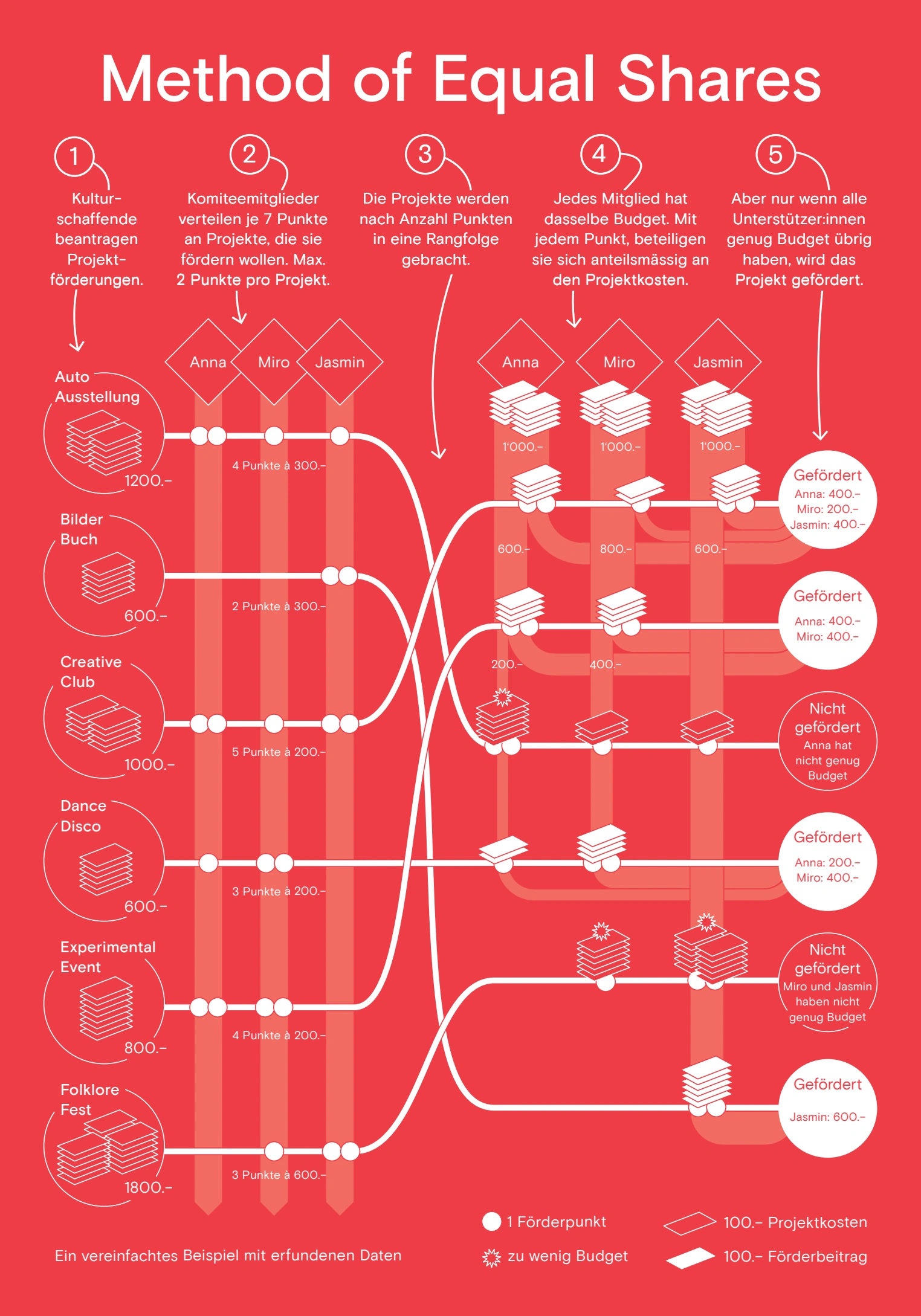
Invented example · 3 people · CHF 1,000 each
Up to two per project. The handout puts projects in order of total points.
| Project | Cost / CHF | Anna | Miro | Jasmin | Points |
|---|
Points express preferences. Budgets determine which contributions can still be made.
Five points → CHF 200 per point. Green shows the remaining budget.
CHF 400 + 200 + 400 = 1,000
The project is funded. Each contribution is deducted from that person’s budget.
After Creative Club and Experimental Event are funded, Anna has CHF 200 left.
4 points · CHF 1,200 ÷ 4 = 300 per point
The handout’s rule skips this project because Anna cannot cover her contribution. No budget is deducted.
Two projects are skipped when supporters cannot cover the contributions shown.
| Project | Points | Funding / CHF |
|---|
All three budgets are spent. Jasmin’s remaining CHF 600 funds Bilder Buch, which has two points.
Creative Club: Anna 400 + Miro 200 + Jasmin 400 = CHF 1,000. Auto Ausstellung is skipped: Anna has CHF 200 left but would need CHF 600.
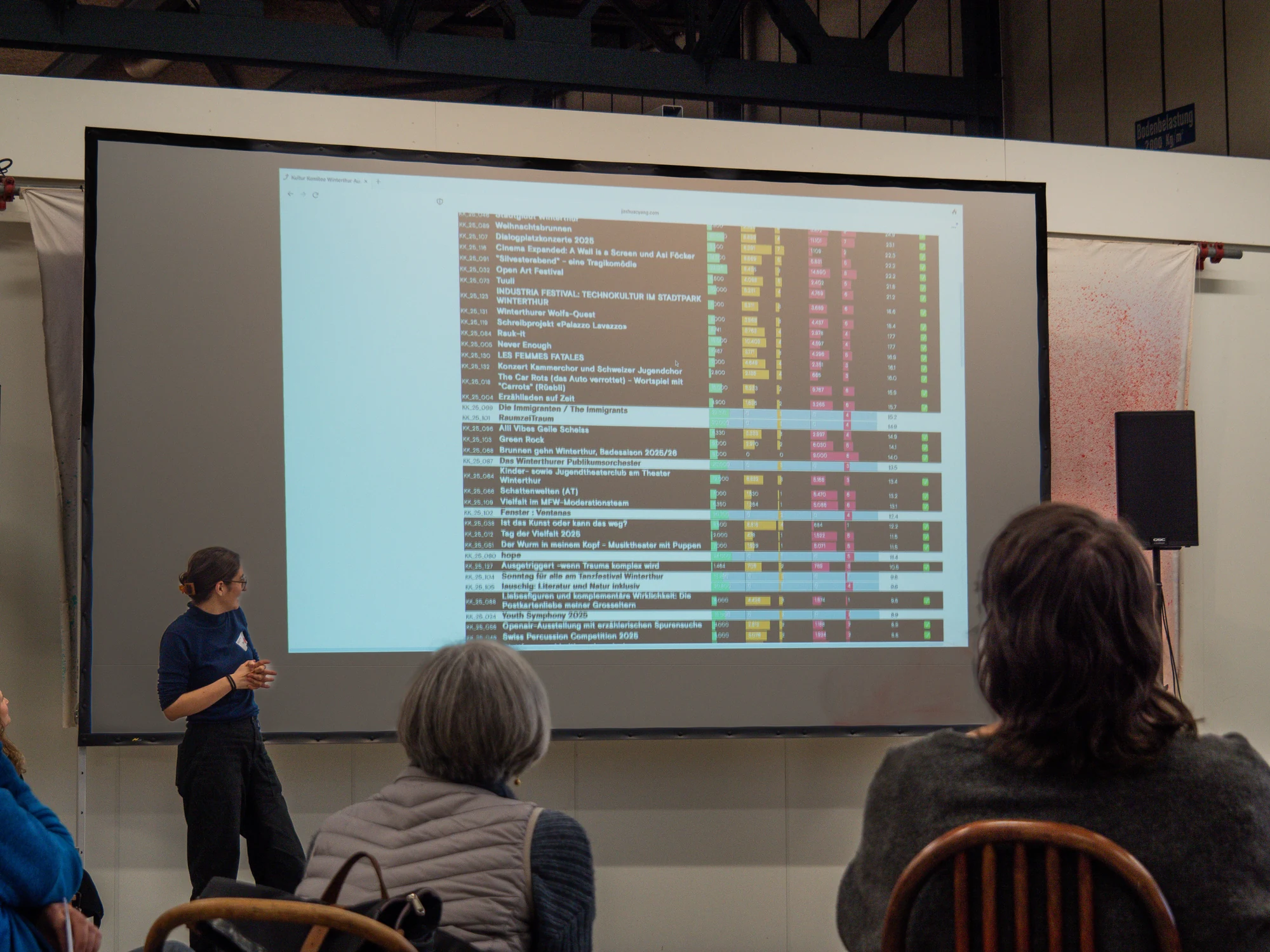
The 2025 allocation funded 43 projects. Receipts connect contributions to the projects that received funding.
Let democracy inform system design: give affected people a voice, a way to challenge decisions, and a role in revising the rules.

What could we learn before bringing people together?
Rehearse a discussion. Vary the evidence, facilitation or decision rules.
Explore responses grounded in consenting participants’ accounts.
Help someone explore arguments, then let them edit and approve their position.

Use simulations to develop questions. People retain voice and decision authority.
Residents propose and choose local projects.
Cyclists rate routes. Shared evidence makes gaps in the network visible.
Explore an issue, compare perspectives and discuss before forming a view.
Ask a question about city information and check the original source.
I can contribute an idea.
I can see how others interpret it.
I can revise or conditionally support proposals.
I can participate in a consequential collective decision.
I can trace what happened afterward.
Adjust the rules. See what changes. Play with the budget ↗
Let’s improve how it works, one real process at a time.

Start with an existing institution and a person’s task. These examples identify possible difficulties and prototypes; the proposed tools are not claimed to be deployed by the institutions.
Download the research and civic-process guide (.md)
Adapted from Joshua’s Motivation 1, slide 3 of Self-Introduction.pptx. The diagram shows selected institutional influences. “Open source” is an analogy for studying and adapting rules; it does not imply equal access to political power or automatic improvement.
The 1787 constitutional compromise combined a House apportioned by population with two senators per state. US Senate
The 1848 Swiss Constitution established a bicameral federal parliament, using the United States as a model. Swiss Parliament: 1848
Australia combines parliamentary government responsible to the elected house, drawn from Westminster, with a federal Senate inspired by the United States. Australian Parliament
The Australian Constitution took effect with federation on 1 January 1901. Australian Constitution
The Parliament Acts of 1911 and 1949 permit certain public bills to pass without Lords consent. The 1949 Act reduced the delay for eligible non-money bills from two years to one. Money bills and other categories have different provisions; the Lords did not lose every veto. UK Parliament
The optional federal legislative referendum dates to 1874. The mandatory constitutional referendum already existed in 1848. Swiss Parliament: referendums
The federal popular initiative for partial constitutional revision dates to 1891. The initiative for total revision predates this, going back to 1848. Swiss Parliament: initiatives
Preferential voting for the House of Representatives was introduced in 1918; compulsory voting at federal elections in 1924. Senate proportional representation was enacted in 1948 and first used in 1949, not at federation in 1901. Australian Electoral Commission
Political participation was historically restricted. Swiss women gained federal voting rights in 1971. Swiss Federal Archives
The US framers drew on British institutions and state constitutions. The connection represents selected institutional precedents, not a literal fork of modern Westminster government. US Senate: British and state precedents
Proportional election of the National Council was approved in 1918 and first used in 1919. Swiss Parliament: proportional National Council elections
Process. A federal popular initiative proposes a constitutional change; an optional referendum challenges legislation.
A concrete difficulty. A voter or organizer needs to understand the text and the published procedural status.
Possible prototype. A comparison of the proposal with the status quo, or a tracker using official records.
Evaluation. Can a reader find the relevant passage and explain what is being proposed?
Process. Fachvereine and VSETH represent students in departmental and ETH-wide bodies; VSETH’s members’ council governs its own budget, elections and statutes.
A concrete difficulty. A student needs to identify who can act and what has already been discussed.
Possible prototype. An agenda brief or issue record connecting a concern, evidence, the responsible body and its response.
Evaluation. Can another student identify the responsible body and the present status?
Process. Participants examine evidence, discuss alternatives and produce recommendations or consultation outputs.
A concrete difficulty. An important concern can disappear when discussions are summarized.
Possible prototype. A source-linked correction or unresolved-question record.
Evaluation. Compare the account with original contributions; count unsupported claims and missing requirements.
Process. Develop proposals, assess feasibility and allocate a limited budget using a defined procedure.
A concrete difficulty. A proposer needs to meet requirements; a participant needs to understand how the allocation was produced.
Possible prototype. A feasibility checklist, comparison of rules, or readable allocation receipt.
Evaluation. Hold ballots and costs fixed for a rule comparison; ask a participant to explain an allocation.
Decide Madrid process · Komitee Equal Shares · Public KK26 receipts
The supplied Method of Equal Shares handout is a simplified example with invented data: three people each have seven points and CHF 1,000. The walkthrough follows the printed order and contributions. It illustrates budget exhaustion, not the full Komitee procedure or real allocation data.
Creative Club receives CHF 1,000, Experimental Event CHF 800, Dance Disco CHF 600 and Bilder Buch CHF 600. Auto Ausstellung and Folklore Fest are skipped. Each person spends CHF 1,000.
Open the original one-page handout (PDF) · Download the transcribed example (JSON)
Process. Connect an adopted proposal to responsibility, implementation and public reporting.
A concrete difficulty. A resident can see that a proposal was approved but cannot tell what happened next.
Possible prototype. A proposal-to-implementation record using existing milestones and evidence.
Evaluation. Can a reader identify the current status, responsible body and supporting record?
These fields overlap. The selection is a reading guide, not a chronology or an exhaustive map. Recent topics include AI-mediated deliberation, allocation with feasibility constraints and agents grounded in human self-reports.
Hélène Landemore: inclusive deliberation and cognitive diversity provides a political-theory starting point.
Voting rules, proportional allocation and fair selection of representatives.
Develops proportionality axioms and allocation rules for projects with different costs and additive utilities; a foundation for the Method of Equal Shares.
Limit. A guarantee depends on its preference model and precise axiom. It does not make every outcome fair under every definition.
Optimizes selection probabilities among volunteers while meeting demographic quotas; evaluates fairness on data from ten assemblies.
Limit. Fairness within the volunteer pool does not solve unequal willingness or ability to volunteer.
Proposes proportional rules for scored preferences under general feasibility constraints, and proportional rankings.
Limit. A theoretical proposal, not a deployment evaluation. Constraints and the definition of proportionality must be specified.
Selects statements representing different groups under a text-length budget. Guarantees depend on formal preferences and query assumptions; a fluent summary alone does not establish fair representation.
Inclusion, reason-giving, public judgment and legitimate authority.
Two studies with 699 people found a shared factor in small groups’ performance across tasks, associated with social sensitivity and conversational turn-taking.
Limit. These associations do not show that equal speaking time causes better decisions, or measure democratic legitimacy.
In numerical estimation tasks with 144 participants, seeing others’ estimates reduced diversity and increased confidence without a corresponding improvement in collective accuracy.
Limit. An estimation experiment is not a general verdict against discussion; task and interaction structure matter.
Describes a system that maps agreement patterns and surfaces statements supported across opinion groups, with real consultation cases.
Limit. A useful map of participants is not a representative estimate of an entire population or evidence that consensus is always desirable.
Combines personal preferences with group evaluations and allocation receipts. In Winterthur in 2025, 38 citizens allocated CHF 380,000 to 43 projects.
Limit. One deployment, with 32 survey respondents. Simulated comparisons do not isolate every component’s causal contribution.
How people use, question and correct AI assistance during participation.
The Habermas Machine uses opinions and critiques to revise group statements. Across experiments with 5,734 participants, AI statements were preferred to those from human mediators.
Limit. Preference for a statement is not proof of factual accuracy, legitimate authority, or lasting political agreement.
Studies how voting-system design shapes citizens’ perceptions of fairness and legitimacy in participatory budgeting.
Limit. Perceived fairness and actual understanding are different outcomes; evaluate them separately.
Explains how isolating a technical model from its social setting can undermine fairness goals.
Limit. A conceptual analysis of system design, not an empirical guarantee that a particular civic tool is fair.
Synthetic responses could match survey averages while understating variation and changing statistical relationships. Results were sensitive to prompts and collection dates.
Limit. The study tests particular models and tasks; use its evaluation questions rather than assuming identical failures for every later model.
How group learning, coordination and judgment emerge from interactions, networks and feedback. Experiments on collective intelligence and social influence sit alongside models of interacting agents.
Two studies with 699 people found a shared factor in small groups’ performance across tasks, associated with social sensitivity and conversational turn-taking.
Limit. These associations do not show that equal speaking time causes better decisions, or measure democratic legitimacy.
In numerical estimation tasks with 144 participants, seeing others’ estimates reduced diversity and increased confidence without a corresponding improvement in collective accuracy.
Limit. An estimation experiment is not a general verdict against discussion; task and interaction structure matter.
Builds agents from interviews and/or surveys of 1,052 Americans and evaluates predictions on held-out responses against people’s own test–retest consistency.
Limit. Predictive fidelity on studied tasks does not confer consent or political authority. The earlier title was Generative Agent Simulations of 1,000 People.
Maintains explicit proposition-level stances with configurable evidence uptake and prior anchoring, recording the evidence associated with updates.
Limit. Evidence scoring and update rules are modeling choices. An inspectable trace is not by itself a faithful simulation of a citizen.
Murmi and voting receipts open as embedded public pages. Offline view keeps local explanations and photos. The voting, opinion-group and summary exercises are labeled illustrations. Sources and further reading below support the four research directions.